
A rough track puts your vehicle’s front end directly in the path of low-hanging branches, loose rocks, and unexpected wildlife crossings. A bull bar provides essential front-end protection, but choosing the right one involves much more than evaluating appearance or a rugged finish. For Mitsubishi Pajero Sport owners, selecting a bull bar requires balancing precise fitment, safety system compatibility, weight distribution, and accessory integration.
The ideal bull bar suits both your off-road terrain and your everyday driving needs ensuring your 4WD handles school runs, daily commuting, and long highway journeys without compromise.
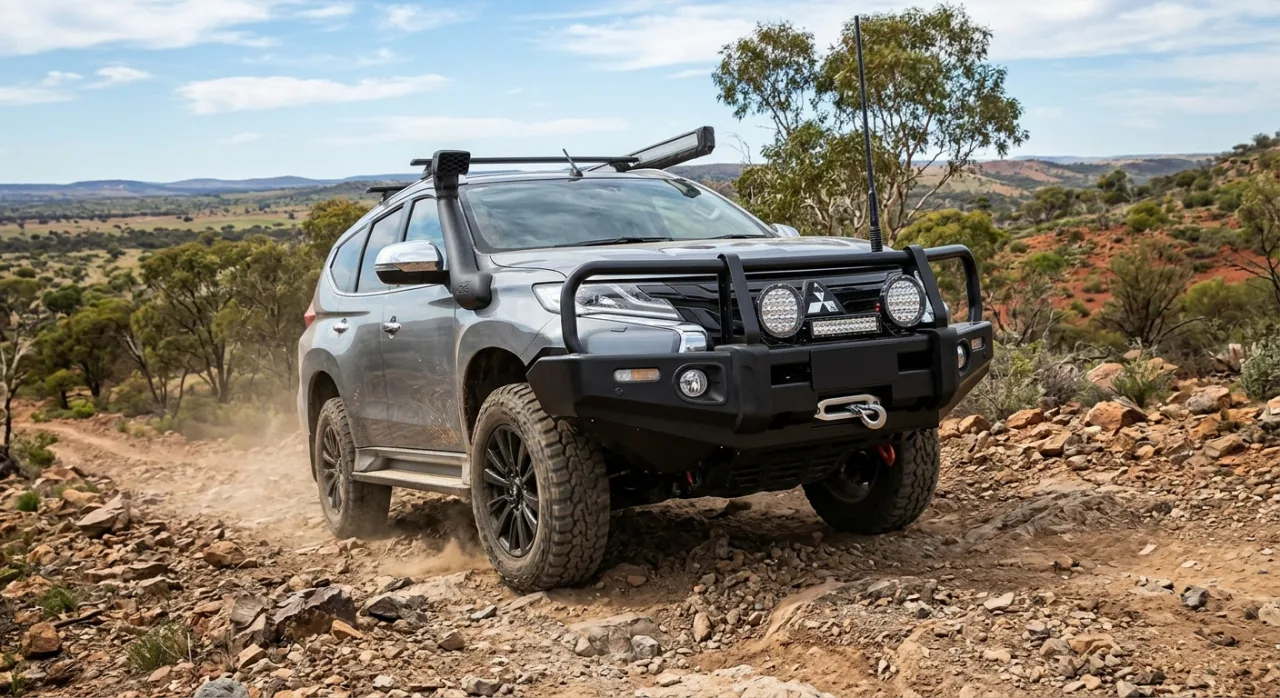
Match Front-End Protection to Your Off-Road Plans
Not every driver requires the maximum level of front-end protection. Driving habits, intended routes, and everyday comfort dictate the ideal design:
-
Light Touring & Gravel Roads: Casual weekend campers travelling along well-maintained dirt roads benefit from compact, lightweight designs that preserve ground clearance and limit front-end weight.
-
Remote Overlanding & Remote Tracks: Serious touring drivers tackling rocky mountain trails or remote regions with frequent wildlife activity require heavy-duty, full-coverage protection extending across the front corners.
Select protection based on where your vehicle actually goes. Investing in heavy-duty overlanding extras adds unnecessary weight and expense unless those features serve a clear, practical purpose on your primary routes.
Choose Materials That Suit Your Priorities
Every material presents distinct performance characteristics, structural benefits, and trade-offs:
| Material | Key Advantages | Primary Considerations | Best For |
| Steel | High structural strength; excellent winch support; maximum impact resistance | Higher overall weight; requires regular coating maintenance to prevent surface rust | Heavy-duty touring, winch installations, and high-impact environments |
| Aluminium | Lightweight construction; preserves valuable payload capacity; inherently rust-resistant | Different flex and strength characteristics compared to steel; harder to repair in the field | Weight-conscious builds, moderate off-roading, and daily drivers |
| Engineered Polymer | Excellent impact absorption; lightweight; resilient against minor scrapes | Varies significantly in construction quality across brands; limited winch compatibility | Light off-roading, urban commuting, and fuel-efficiency priorities |
Always look beyond the base material. Mounting strength, fabrication quality, multi-stage corrosion protection, and documented impact testing offer a far better comparison standard than material type alone.
Ensure Safety Compliance and Vehicle Compatibility
A quality bull bar must be engineered specifically for your vehicle’s exact variant and model year. Minor factory variations directly impact mounting points, structural fitment, and electronic sensor performance.
Critical Safety Checks:
-
Airbag Compatibility: Verify that the bull bar has undergone documented crash testing and complies with official Australian Design Rules (ADR) or equivalent local vehicle safety standards. Generic fitment claims do not guarantee correct airbag deployment timing.
-
ADAS & Sensor Integration: Modern Pajero Sport models feature factory parking sensors, front cameras, autonomous emergency braking (AEB) radars, and lane-keep sensors. Ensure the bar features dedicated mounting provisions and recalibration support so these driver-assist systems function without error.
-
Professional Installation: Professional fitting ensures correct mechanical torque settings, seamless electrical integration for sensors, and solid alignment with original body panels.
Integrate Winches, Lights, and Recovery Points Early
Plan your accessory layout prior to purchasing a bull bar to prevent expensive refits or replacements later:
-
Auxiliary Driving Lights & Antennas: Ensure integrated mounting brackets exist for LED light bars, spotties, and UHF aerials.
-
Winch Compatibility: A winch places extreme stress on the front structure. Verify the bar’s rated winch capacity and internal cradle design rather than assuming fitment based on external space.
-
Rated Recovery Points: Never use decorative holes or accessory brackets for vehicle recovery. Ensure the bull bar incorporates, or safely accommodates, dedicated, rated recovery points designed for direct snatch or winch recoveries.
Balance Added Weight with Everyday Handling
Adding a bull bar, winch, and driving lights places substantial weight directly over the front axle. This forward load affects suspension performance, braking distance, and available payload capacity.
-
Calculate Gross Vehicle Mass (GVM): Combine the weight of the bull bar, accessories, passengers, and gear to ensure your vehicle remains within legal GVM limits.
-
Upgrade Front Suspension: If adding a heavy steel bar and winch, install upgraded front springs and shock absorbers to restore ride height, preserve suspension travel, and maintain handling stability.
-
Optimize Approach Angles: Choose a high-clearance design that improves your front approach angle, allowing the vehicle to clear steep inclines and deep ruts without scraping.
Final Thoughts
A well-engineered bull bar delivers vital physical protection while integrating seamlessly with your vehicle’s safety systems, suspension geometry, and touring equipment. For the Pajero Sport, the right selection depends on accurate weight management and realistic off-road requirements rather than aggressive styling alone.
By matching construction materials to your routes, confirming ADR safety compliance, and planning your accessory layout in advance, you achieve a reliable setup built for both rugged outback tracks and smooth urban driving.