
If your vents blow weakly, the AC smells musty, or the windshield takes forever to defog, check the cabin air filter first. It is a cheap, replaceable part that cleans the air coming into the passenger compartment, and many manufacturers schedule it for roughly every 12,000 to 15,000 miles or about once a year.
Diagnosis: What a Cabin Air Filter Does
Outside air passes through this filter before it reaches the dashboard vents and floor outlets. Most cars place it behind the glove box, under the dash, or near the windshield cowl.
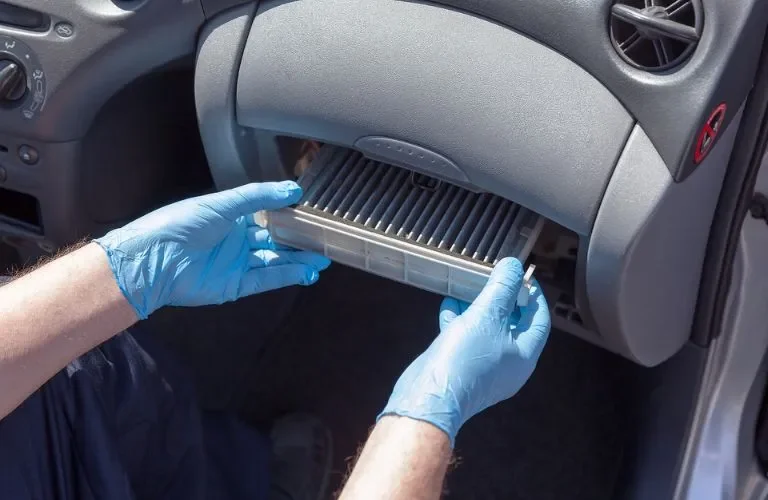
The filter traps the particles that build up in an enclosed cabin:
- Dust from dry roads, gravel, and construction zones.
- Pollen from trees, grass, and plants, which matters for allergy sufferers.
- Traffic pollution such as road dust and smoke particles. Carbon versions also adsorb some gases and odors, though no filter removes every harmful gas.
It is not the engine air filter. That one protects the engine’s intake. The two are not interchangeable, and each needs its own service.
Warning Signs Your Filter Is Clogged
- Weak airflow even though the fan runs normally.
- Musty or stale smell when the heat or AC comes on.
- Dust settling quickly on the dashboard.
- A louder or strained blower on high settings.
- Slow defogging, because restricted airflow can’t clear moisture from the glass.
Some of these overlap with other faults. A failing blower motor or blocked ducts can cut airflow, and a smell can come from moisture in the evaporator.
Choosing the Right Filter Type
| Filter type | Best for | What to know |
|---|---|---|
| Standard particulate | Everyday dust, pollen, dirt | Affordable layered paper or synthetic fiber |
| Activated carbon | City traffic, industrial areas, smoke | Adds odor and some gas control; results depend on how much carbon is used |
| High-efficiency | Fine dust and microscopic particles | Confirm fit and airflow for your car; “HEPA-style” labels are not the same as true HEPA |
True HEPA is a defined standard, usually stated as capturing 99.97 percent of particles at 0.3 microns. Many automotive filters marketed as “HEPA-grade” don’t meet it, so read the actual specs.
Step-by-Step Replacement SOP
Most owners can do this in a driveway. Some models need no tools. Others require removing a dash panel.
- Find the part number. Confirm make, model, year, and trim in the owner’s manual or a reliable parts catalog. Similar-looking filters can differ in size.
- Locate the housing. Park safely and switch the ventilation off.
- Open access. Empty the glove box and release its side stops or clips, or remove the access cover. Use a plastic trim removal tool rather than a screwdriver so you don’t crack older clips.
- Note the airflow arrow on the old filter’s frame, then slide it out.
- Clean the compartment. Remove leaves and loose dirt with a vacuum crevice nozzle, without pushing debris deeper into the ducts.
- Fit the new filter with the arrow pointing the same way. It should sit flat with no gaps or bends at the edges.
- Reassemble the housing and glove box, then run the fan on high to check airflow.
How Often to Replace It
There’s no universal interval. Follow your manufacturer’s schedule, commonly about 12,000 to 15,000 miles or once a year. Replace it sooner if you drive on dusty roads, near construction, through heavy city traffic, or around farmland.
A quick visual check helps between services. Pull the filter and look at the pleats. If they are gray, packed with debris, or hold leaves and insects, replace it now rather than waiting for the mileage. Pollen season and winter salt-and-grit months are good times to look.
Filter Swap Problems and Quick Fixes
Filter installed backward
If airflow is still weak after a fresh install, pull the filter and check the arrow. Reversed filters are one of the most common errors.
Musty smell doesn’t go away
If a new filter doesn’t fix the odor, moisture or microbial growth in the evaporator may be the source. That calls for an AC system inspection, not another filter.
Wrong size letting air bypass
A filter that bends or leaves edge gaps lets unfiltered air through. Return it and buy the exact part number. Also avoid a filter so dense it chokes airflow in your system.
Quick FAQ
- Can I wash and reuse it? Most standard filters are designed to be replaced. Washing or blowing them out can damage the media.
- Will a clogged filter hurt the engine? Usually not directly, but it cuts ventilation, comfort, and defrosting.
- Does a new filter stop all pollution? No. It reduces particles and, with carbon, some odors.
Getting the Next Filter Change Right
- Check the manual for your filter’s location and interval.
- Buy the exact part number from a trusted parts supplier.
- Pick standard, carbon, or high-efficiency based on where you drive.
- Match the airflow arrow and check for a tight, even fit.
- Investigate the evaporator if odors persist.