
A truck that feels unbeatable on pavement can lose its footing fast once the surface turns to mud, standing water, or broken rock. The fix is not one big upgrade. It is the right tires plus a hard look at suspension, fluids, brakes, electrics, and the 4WD system before you leave the driveway.
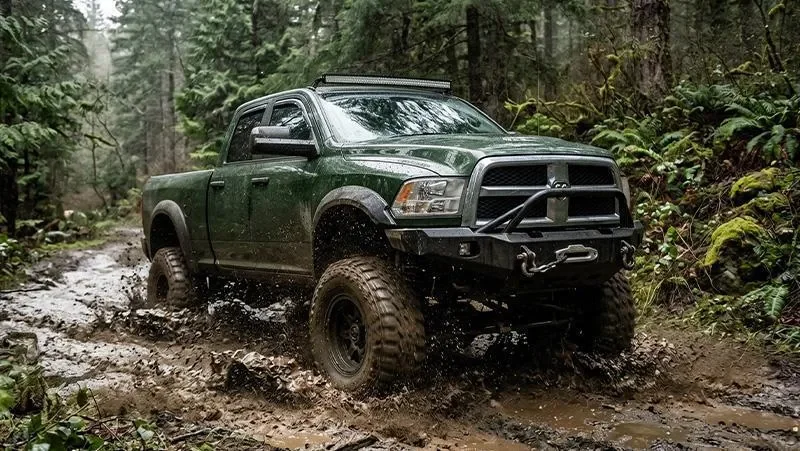
Off-road driving loads every part of the chassis at once. Skipping the checks below is how a weekend trail run turns into a tow bill.
Diagnosis: Where Rough Terrain Hurts a Truck First
Mud, rain, and rocks stress five systems more than anything else. Use this table to decide where to spend your prep time.
| System | What rough terrain does to it | What to check before leaving |
|---|---|---|
| Tires | Sidewall cuts, punctures, poor water evacuation | Tread depth, dry rot, load rating, sidewall condition |
| Suspension | Amplified wear on every joint and bushing | Shocks, ball joints, tie rods, bushings, springs, skid plates |
| Engine and fluids | Heat from slow, heavy, high-friction driving | Oil, coolant, radiator fins, belts, air filter, diff and transfer case fluid |
| Brakes and electrics | Mud and water on rotors, corrosion on terminals | Pads, rotors, lines, brake fluid, battery terminals, lights |
| Drivetrain | Heavy torque loads at low speed | 4WD engagement, diff locks, driveshafts, CV boots |
Step 1: Match Your Tires to Where You Actually Drive
Tire choice comes down to the surfaces you cover most. Be honest about how much time the truck spends off-road versus on the highway.
- All-terrain tires balance highway manners with solid grip on dirt, gravel, mud, and light snow.
- Mud-terrain tires use aggressive tread blocks and wide voids that paddle through soft soil and throw out packed mud. Their reinforced sidewalls resist gouges and pinches from rocks and branches.
Mud-terrains come with trade-offs. They are louder, roll with more resistance, burn more fuel, and can be mixed on wet pavement. Less siping and a smaller contact patch can lengthen braking distances on rain-soaked asphalt.
Whatever you run, confirm there is enough tread depth to clear water, no dry rot or structural damage, and the correct load rating for your truck.
Step 2: Inspect Suspension and Underbody Protection
Worn suspension dulls steering and stops the tires from staying planted on uneven ground. Get under the truck and check:
- Shocks and struts for oil leaks, dents, and worn mounts.
- Ball joints and tie rod ends for play or looseness.
- Control arm bushings for cracking, dry rot, or breakdown.
- Coil or leaf springs and mounts for cracks, heavy rust, or uneven sag.
- Skid plates for tight bolts over the transfer case, oil pan, and differential.
A lift kit adds clearance, but it does not make a truck trail-ready on its own. Healthy hardware does.
Step 3: Check Fluids, Cooling, and Air Intake
Slow crawling under load builds heat in both the engine and transmission. Check engine oil level and condition, the coolant reservoir, radiator fins for damage or dried mud, and radiator hoses.
Check transmission fluid using the manufacturer’s procedure. Then confirm front and rear differential and transfer case fluid levels and seals. Look over belts and hoses for cracks or fraying, and inspect the air filter, since flung mud and dust can clog it quickly.
Deep water is the big one. If the intake draws water in, the engine can hydrolock. Four-wheel drive does not make a water crossing safe.
Step 4: Confirm Brakes, Electrics, and 4WD
Inspect pads, rotors, calipers, and lines, then top up brake fluid and look for leaks. Clean corrosion from battery terminals and check any wiring exposed to water or debris. Make sure headlights, brake lights, and turn signals all work.
Engage 4WD before the trip to confirm it shifts without hesitation, and test diff locks if fitted. Check driveshafts and CV boots for play, tears, or leaks. As a rule, use 4H to hold momentum on wet gravel or light mud, and 4L for slow, high-torque work like deep ruts or steep climbs. Follow your owner’s manual for specifics.
Tools Worth Carrying
Pack a properly rated recovery strap, traction boards, a shovel, work gloves, and a tire-pressure gauge. A portable 12-volt air compressor lets you air down for a wider footprint in soft ground and reinflate before the pavement. Use the gauge to bring tires back to the pressure on the door-jamb placard, not a guess.
When the Trail Turns Against You
Spinning the wheels in deep mud
Excess wheelspin digs the tires deeper and can leave the truck high-centered. Ease off, keep a steady throttle, and if you are stuck, dig out the tires and use traction boards or a strap rather than flooring it.
Driving into water of unknown depth
Never cross standing or moving water when you can’t judge depth, current, or what the roadbed is like underneath. Walk it or turn around. A hydrolocked engine is a far bigger repair than a detour.
Weak brakes after a muddy stretch
Mud and water on the rotors cut stopping power. Test the brakes gently at low speed in a safe spot right after leaving wet terrain to clear debris before you pick up speed.
Post-Trip Action Checklist
- Reinflate tires to the recommended pressure before driving on pavement.
- Wash mud from the undercarriage, wheel wells, and suspension before it hardens and traps moisture.
- Check tires for punctures, sidewall cuts, and stones in the tread.
- Look for impact damage on skid plates, exhaust, and suspension mounts.
- Recheck all fluid levels for new leaks.
- Note any new vibration, pulling, or change in brake feel and fix it before the next trip.